
The Apology of Imperialism: The Pharisaic Path of False Democrats
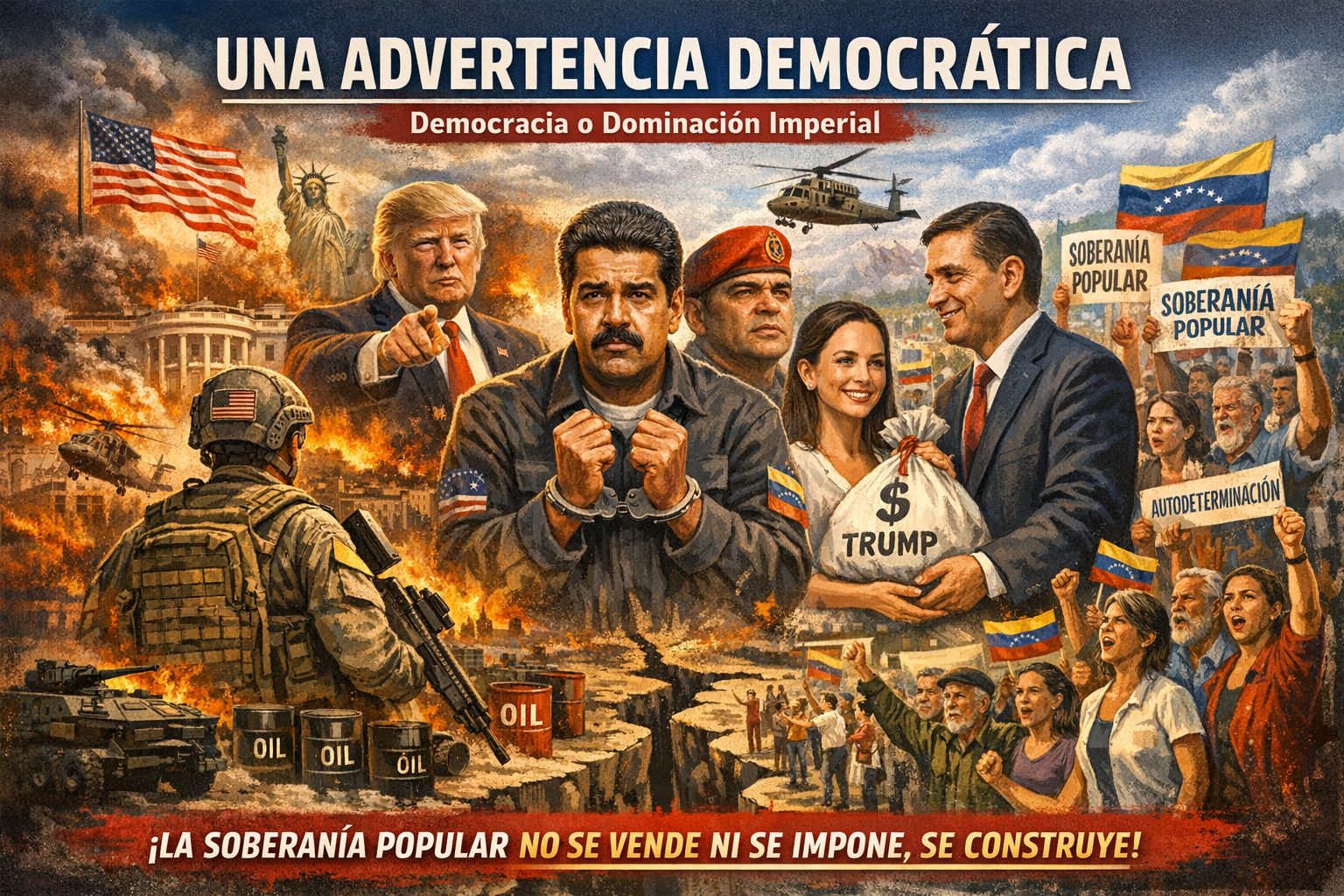
A Democratic Warning
Mr. Marco Aurelio Peña, a Nicaraguan, has published an article entitled “The Arrogance of Indolence,” whose sole merit, if any, lies in condensing the defense of American military and political intervention—portrayed as a liberating, humanist act, essential for the restoration of democracy in Venezuela.
Yet his text betrays a profoundly anti-democratic stance, aligned with the most extreme interests of the international far right, devoid of sequential analysis and overtaken by visceral reaction, indifferent to both the immediate and long-term consequences of the measures it espouses.
Our critique unfolds along seven axes: (1) the author’s ideological premises, (2) the legitimacy and legality of intervention, (3) the actual feasibility of a democratic transition under imperial occupation or tutelage, (4) the ethics of the Venezuelan opposition and its relationship with imperial power, (5) the perils of precedent and the denial of popular sovereignty, (6) the caricature of critics and contempt for democratic debate, and (7) the dangerous precedent for Latin America.
1. Ideological Premises and the Betrayal of Liberal Democracy
Peña’s article stands firmly in the tradition of a certain Latin American right—long representatives of politically dominant sectors since independence—which welcomes, and oftentimes openly invites, foreign intervention to shore up or safeguard its interests, whether threatened by intra-elite struggles or the specter of the “left.” With remarkable alacrity, these actors shed all liberal and republican principles, discarding them in favor of an imperial “solution.” Thus, the emperor is left naked, as in Andersen’s famous fable.
Strikingly, the author never pauses to ask what democracy means, nor to ponder the value of popular sovereignty. It is simply assumed that democracy may be imposed, that a people may be “liberated” by foreign military force, and that international legality is irrelevant beside the suffering inflicted by Chavismo.
This posture represents, in essence, a denial of the foundational values of liberal democracy. If democracy is government by the people, and sovereignty resides in the citizenry, then any process that excludes or supplants the popular will cannot rightly be called democratic.
Peña invokes Rousseau superficially, as if the armed intervention of a foreign power were compatible with the “exercise of the general will.” The contradiction is glaring: he champions a model in which the sovereignty of the Venezuelan people is ignored and replaced by the will of the American president and his national security team.
Liberal democracy is not merely the product of periodic elections; it is, above all, the guarantee that the people are subjects of politics, not its objects. By celebrating Maduro’s capture and the imposition of a new leadership under American tutelage, Peña endorses the notion that democracy can arise from the negation of national and popular sovereignty. This is a grave conceptual and political error.
2. The Illegality of Intervention and Contempt for International Law
The article openly mocks those who denounce violations of the UN Charter and international law. It ridicules “sovereignists and principlists” for their adherence to legality, accusing them of arrogance and indolence. Yet it must be recalled that the international order, with all its imperfections, was established precisely to prevent the unilateral intervention of powers in sovereign nations. The abduction of a head of state, even if de facto, the imposition of a government without democratic mandate, and the appropriation of a nation’s resources are grave violations of international law and elementary principles of justice.
Peña wonders aloud whether international law could contain Hitler or Stalin, seeking to justify intervention by likening it to the struggle against totalitarianism. The argument is specious. The fight against European totalitarianism required international alliances, consensus among states, and the creation of multilateral institutions. The unilateral intervention of the United States in Venezuela—without authorization from its Congress, without the backing of the UN or regional allies, and carried out by a president who openly repudiates democratic values—bears little resemblance to the legitimate combat against genocidal regimes. On the contrary, it reopens the wounds of a colonial and neo-colonial past that Latin America has suffered for centuries.
International legality is not a whim of “dubious intellectuals”; it is the minimum foundation for coexistence among states and for the protection of peoples’ rights. To scorn it is to open the door to the law of the jungle, to perpetual war, and to the reign of brute force. By celebrating the use of force and ridiculing his critics, Peña legitimizes a policy that can only breed chaos and international insecurity.
3. The Fallacy of “Democratic Transition” Under Occupation and the Continuity of the Chavista Apparatus
Perhaps the most cynical aspect of Peña’s article is its tacit admission that, after intervention, there is no genuine transition to democracy. Trump himself has made plain that he cares little for democracy, only to keep the oil (“our land and our oil,” reiterates the American president). The vice president of Maduro is recognized as president, the principal Chavista cadres remain in power, and the military and police apparatus is left intact.
Peña concedes that “Chavismo still holds the levers of command” and that “no one knows how the transition might be realized.” Yet, instead of analyzing the foreseeable consequences of this arrangement, he opts for a superficial glorification of the present moment. There is no sequential analysis, no reflection on “what happens next.” How can a functional democracy emerge when those who wielded authoritarian power continue to govern, now under foreign tutelage? What incentives do they have to open the political system? What guarantees exist for civil society, opposition parties, and ordinary citizens? All these questions must be asked; above all, they demand rigorous reflection. What is the purpose of thought if we do not confront these matters of life and death?
It is not only recent history, but the entire history of imperial interventions that demonstrates how rarely, and only by unforeseen or accidental outcomes, do successful transitions to democracy occur. The recent cases of Iraq, Afghanistan, Libya, and other nations subjected to foreign intervention show that occupation or imperial tutelage typically leads to chaos, fragmentation, corruption, and the perpetuation of authoritarian elites. Peña deliberately ignores these lessons and suggests that the optimism of exiles and the victims of Chavismo justifies any action—regardless of its consequences.
4. Ethics and Contradictions of the Venezuelan Opposition: The Case of María Corina Machado
The most striking irony in Venezuela’s current political crisis—and one Peña conveniently omits—is the attitude of the opposition. For years, this opposition has insisted on “peaceful solutions” and refused to organize any form of armed resistance to the dictatorship, in the name of “civility” and “peace.” Yet it has had no qualms, and indeed has appealed to and applauded, foreign military violence against its own country. They do not hesitate to justify foreign military intervention, but reject the exercise of citizen resistance, even though every democratic code recognizes the right of peoples to rebel against tyranny.
The shameful act of opposition leader María Corina Machado—offering Trump the Nobel Peace Prize from Oslo, journeying to Washington to present him with a medal—revealed the degree of the opposition’s subservience to imperial power. The gesture not only provoked an unprecedented statement from the Nobel committee, declaring the prize non-transferable, but exposed Machado to public humiliation: she was not received publicly, received nothing more than a shopping bag bearing Trump’s signature, and became the object of near-universal criticism, especially among Venezuelans.
While she courted imperial favor, the Trump administration revoked temporary asylum for 600,000 Venezuelan refugees, and ICE agents shot one of them who sought to remain in the country. Neither Machado nor any opposition figure, nor even the Nicaraguan opposition in the United States, has criticized the militarized persecution—ongoing since January 2026—against immigrants.
The ethics of that opposition stand gravely compromised. Instead of representing the interests of the citizenry, they seem more intent on becoming satraps of empire than restoring popular sovereignty. The eagerness to be “the chosen one” of foreign power, the willingness to sacrifice national dignity, and the silence in the face of repression against their own compatriots in exile, reveal a lack of principle and democratic commitment that deserves the severest condemnation.
5. Imperialism, Resource Allocation, and the Denial of Popular Sovereignty
The article, and the Trump policy it describes, make explicit the colonial nature of the project underway: the United States receives Venezuelan oil, sells it under far more favorable terms than those available before the intervention, and hands over a portion of the proceeds to the provisional government, with no transparency or accountability. How much is pocketed as “commission” remains unknown, and there is no democratic mechanism to oversee the management of these resources.
This model is not a transition to democracy, nor even an enlightened occupation; it is the restoration of the most brutal imperial logic: the powerful intervene, divide the spoils, and secure their own interests. The local population is excluded from decision-making, and “democracy” is reduced to an empty slogan. Peña, in celebrating this policy, betrays not only liberal principles, but also the dignity of Latin American peoples.
The claim that “there is no alternative” is the last rhetorical refuge of those who have abandoned democracy. There are always alternatives: international pressure, the construction of regional alliances, the political organization of civil society—not merely for elections, but for the struggle by all means, legal or otherwise, that constitute the exercise of popular sovereignty. Building alliances with business sectors and government to isolate the authoritarian core; and if necessary, armed struggle—which they approve when it is a foreign military invasion, but condemn when it is a citizen exercise to which all peoples are universally entitled in cases of extreme oppression.
Yet these paths demand patience, political acumen, and respect for the autonomy of peoples. Imperialist intervention, by contrast, destroys local processes and perpetuates dependence.
6. Caricaturing Critics and Disdain for Democratic Debate
Peña mocks “dubious analysts,” “intellectuals,” “sovereignists,” and “principlists,” as if the only valid criterion were the immediate jubilation at Maduro’s fall. But democracy demands debate, reflection, and careful consideration of consequences. To caricature critics as mourners, dogmatists, or indolent souls reveals only an incapacity for rational deliberation.
The contempt for “futurology” is especially striking: how can democracy be built without analyzing the chain of foreseeable events? Is it not the very function of intellectuals and analysts to warn of risks, precedents, and the dangers of intervention? Peña prefers immediate observation to long-term analysis—a recipe, plainly, for disaster.
7. The Dangerous Precedent: Latin America Under Permanent Threat
Finally, one must warn of the precedent being set. If the United States can abduct a head of state, install a government, seize resources, and threaten other countries (Colombia, Mexico, Greenland—this last, an autonomous province of Denmark and member of NATO!)—all without democratic or legal oversight—Latin America enters an era of perpetual insecurity.
Local governments, whether democratic or authoritarian, live under the shadow of intervention, and popular sovereignty is annulled.
The argument that “the people are held hostage” does not justify supplanting the popular will with imperial will. Latin Americans have fought for centuries for self-determination, independence, and democracy. The answer to the problems of authoritarianism is not a return to colonialism, but the patient construction of democratic institutions, the strengthening of civil society, and international solidarity founded on mutual respect.
Conclusion
Peña’s article is, in the final analysis, an apology for imperialism and a radical repudiation of democratic values. His defense of unilateral intervention, his disdain for international law, his lack of sequential analysis, his caricature of critics, and above all, the ethical complicity of the Venezuelan opposition with imperial power, reflect a posture profoundly anti-democratic and reactionary.
Peña is nothing but a lagging, anachronistic, and wholly unoriginal echo of the elitist opinion—generally far-right and anti-democratic—of Latin America’s traditional ruling groups.
History teaches that imperial interventions do not lead to democracy, and that the only lasting solution lies in respect for popular sovereignty and the construction of legitimate consensus.
Democracy cannot be imposed by force, nor can it coexist with the denial of national autonomy. Latin America must reject false dilemmas between local authoritarianism and external imperialism, and embrace the arduous but necessary task of building societies that are free, just, and sovereign. Peña’s article, far from contributing to this endeavor, perpetuates the errors of the past and paves the way for new tragedies.
In sum: the road to democracy in Venezuela—and throughout Latin America—can only be traversed by the peoples themselves, through autonomous, legitimate, and inclusive processes that affirm the popular will, that truly and by every necessary means empower citizens and the nation, that disperse domestic power and liberate the country from any colonial tutelage.
Imperialist intervention, especially when executed by anti-democratic actors and with the complicity of an opposition bereft of ethics and principle, can only lead to deadlock, the division of spoils, and the negation of liberty. It is time to reject facile and superficial solutions, and to commit to the collective construction of democracy.
What has transpired in Venezuela, together with the conduct of power-hungry politicians and false opposition figures eager to sell themselves to the highest imperial bidder, must serve as a democratic warning and prompt us to question their true intentions. Only a vigilant and critical citizenry, capable of exposing both dictators and “democrats” of convenience, can open the way to genuine democratic reconstruction in our nations.
