
Rescuing Democracy: The Twin Threats of Capital and AIPAC
Editorial
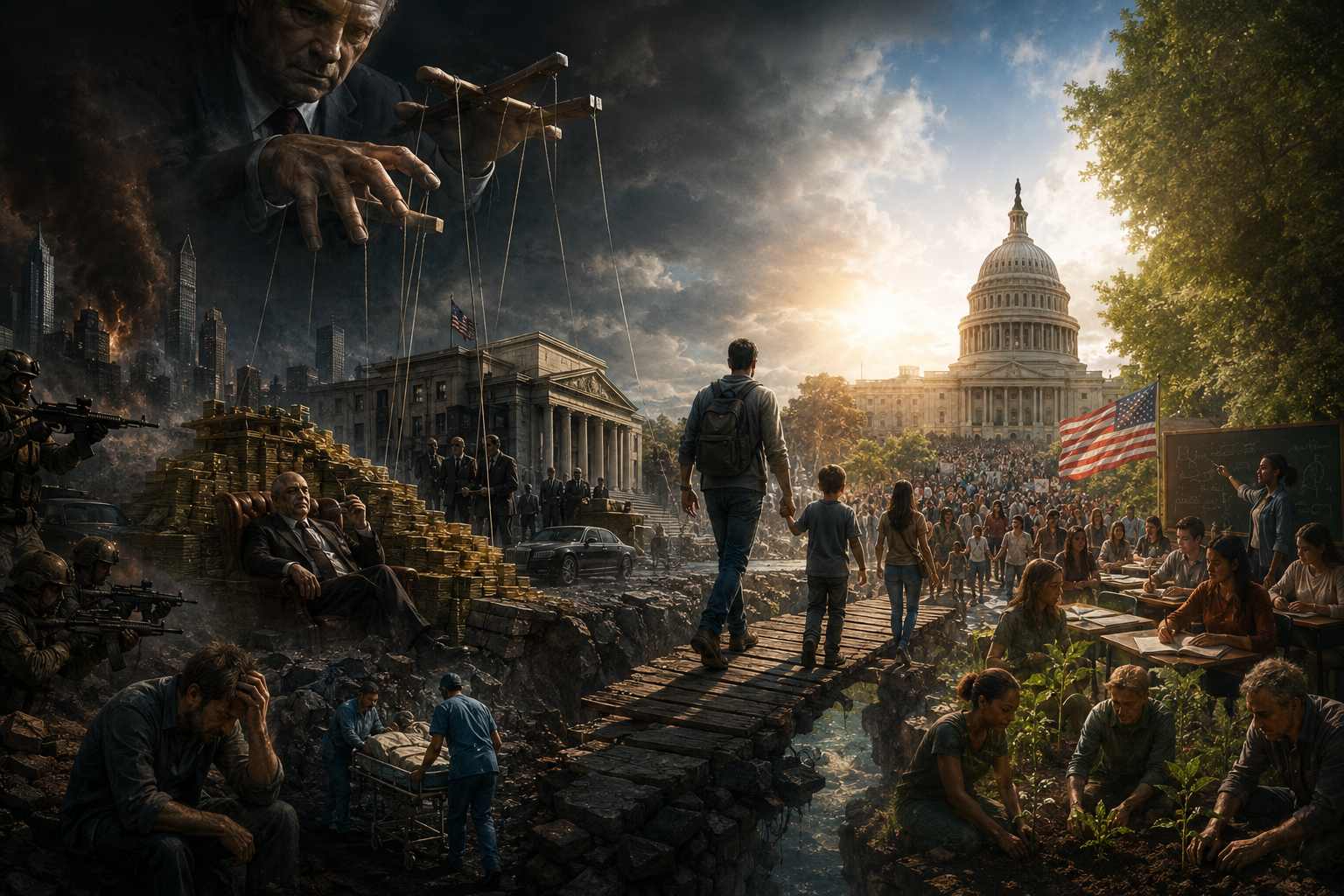
The current generation of Americans faces a dangerous moment in history, under the twin threats of foreign war and democratic dissolution. These threats are not accidents of fate, nor the result of dark conspiratorial forces beyond our reach. They can be traced to two distinct but converging sources within the body politic itself: the growing power of Capital — the oligarchy of the 1% — over American society, and the capture of U.S. foreign policy by AIPAC — the American Israel Public Affairs Committee, the most powerful arm of the pro-Israel lobby — with dire consequences for freedom of speech. To name them honestly is the first act of citizenship in a moment that demands citizenship.
The first threat consists in the grotesquely disproportionate increase in the power of the wealthiest minority in the country. Over the past forty years, wealth in the United States has concentrated at a pace and scale not seen since the Gilded Age of the late nineteenth century, the era of the robber barons. According to the Federal Reserve’s wealth distribution statistics — the nonpartisan data of the government itself — the top 10% of households today owns more than two-thirds of national wealth, and the top 1% owns as much as the bottom 90% combined.
At the other extreme, the poorest 50% of the population barely owns around 2.6% of total wealth, largely in the form of durable consumer goods — vehicles and modest real estate holdings. Put simply: half the population owns virtually nothing, while 10% concentrates nearly 70% of all wealth. Caught between these two poles, and pushed toward ever greater precarity by the evolution of contemporary capitalism and neoliberal policies — offshoring, automation, artificial intelligence, the dismantling of public education, the exorbitant cost of private healthcare — is the remaining 40%, which owns approximately 25% of total assets.
This acute and unstable inequality raises fundamental ethical questions about the value system of a society whose rhetoric rests on freedom and equality of opportunity. The overwhelming dominance of a tiny minority clashes with America’s self-image as a «classless» or «middle-class» nation; it clashes, at the deepest level, with the legitimating narrative of the American power system. But it is also, and more urgently, a brutal political fact: concentrated wealth buys concentrated political power, and is therefore profoundly, essentially, and aggressively antidemocratic. Thus, the 1% writes the tax laws, controls the regulators, hollows out the antitrust laws designed to limit concentrated economic power, delegitimizes and erodes public services, and turns the two major parties into rival managers of the same ruling class. The result is a population that rightly perceives that its government does not respond to its interests, and a political class that treats that perception as a public relations problem rather than as a revealing symptom. Trumpism is not merely a consequence of this rot: it is both its accelerator and its shield; the product of oligarchy turned into a weapon. A billionaire who presents himself as tribune of the forgotten is the most perfected, and most cruel, form of oligarchic camouflage.
The second threat is more specific, but no less grave. AIPAC and its allied organizations have achieved, over decades, a degree of influence over U.S. policy in the Middle East — a strategically and globally decisive domain — incompatible with democratic self-government. Members of Congress pledge to defend a foreign country as if that were their task, when their task is to defend the United States and its Constitution. Politicians who deviate from orthodoxy are systematically defeated through coordinated financing.
Citizens, students, and journalists who criticize the Israeli government, or who defend the human rights of Palestinians, are smeared as antisemites — a slander that trivializes real and growing antisemitism while stifling legitimate debate. The recent and disastrous turn toward war with Iran is the predictable outcome of a foreign policy apparatus that responds to a lobby rather than to the citizenry; but it is also the product of an Executive marked by authoritarian impulse, ideological blindness, and servile adulation, an administration whose contempt for expert knowledge guarantees avoidable errors in the gravest decisions. Captured from without and incompetent from within, the Trump presidency has pushed the country toward war against the manifest interest of the American people.
These two threats converge. Capital and the AIPAC lobby are not identical, but they reinforce each other: a permanent state of war enriches the military-industrial-technological complex — traditional defense contractors, now joined by Silicon Valley companies that provide the Pentagon with surveillance, artificial intelligence, and cloud infrastructure — and that complex finances the politicians who make the state of war permanent. The losers in this convergence are ordinary Americans: those whose children fight, those who bear the burden of present taxes and growing public debt, whose freedom of speech is curtailed, and whose needs go unmet while the oligarchy enriches itself and bombs fall on distant human beings who have neither voice nor vote, only tragedy and endless suffering.
The remedy has a name: democracy. A strengthened and revitalized democracy, with private money out of politics, with foreign lobbies registered and limited, with antitrust legislation rigorously enforced, with the working classes (the vast majority of the population) politically empowered, with public goods restored.
Strengthening and revitalizing democracy also requires confronting the problem of the imperial presidency: an Executive that routinely goes to war without debate or congressional authorization, that uses the Department of Justice as an instrument of political intimidation and repression, that ignores binding international treaties without political cost. The checks and balances designed to contain executive power have proven insufficient now that the Founding Fathers’ nightmare — a powerful demagogue — has seized the White House. Political reform is a short-term priority if the democratic republic is to be preserved.
Preserving democracy also requires a vigorous program of collective action and a mobilization for economic and social justice: a tax system that compels the top 1% to pay their fair share, a wage structure that allows workers to live with dignity, health and education treated as rights rather than commodities, a housing policy oriented toward building, not hoarding. It also means the recovery of freedom of speech as an inherent right — both consequence and precondition of democracy — including the right to criticize any government, one’s own or any other, without suffering political, professional, or social annihilation.
This program is, moreover, the only durable bridge capable of spanning the divisions that the far-right exploits. Xenophobia, Islamophobia, racism, and antisemitism flourish in the fertile ground of material desperation and the search for scapegoats. Drain that swamp — give people security, dignity, and a truthful account of who has taken what from them — and the demagogues will be left without oxygen. Workers conscious that their enemy is Capital — the concentrated wealth that destroys democracy — need not hate their neighbor. They will mobilize, instead, to defend freedom and human rights, within and beyond their borders.
The collapse of democracy, the abandonment of peace, the erosion of international law: none of this is inevitable. It is the work of concrete actors with concrete names. We can name them, organize against them, and replace the system that sustains them. That is today the priority task of those who love freedom. The alternative is a country that retains its flag and loses everything the flag promised to represent in the American democratic tradition.
Avoiding this outcome requires not only undertaking a program of reforms in the direction outlined here but doing so with the urgency that the moment imposes and with the lucidity to understand that the ongoing social disasters spring from the inherent dynamics of the market economy: to prevent, diminish, and mitigate them, social regulation is indispensable.
These disruptive and antidemocratic forces, which emerge from the logic of the market, have grown unchecked and accumulated their effects over more than four decades. It cannot be expected, therefore, that the crises we are already living through will abate with modest reforms or a mere electoral cycle adverse to authoritarianism. Radical, profound social change is a historical necessity if the purpose is a society of free citizens. Necessity, the mother of all true change, demands it. This is not a utopian vision. What is truly utopian is to proceed as if the course correction could be minor, as if rescuing democracy required merely a change of names in the presidency or Congress.
